
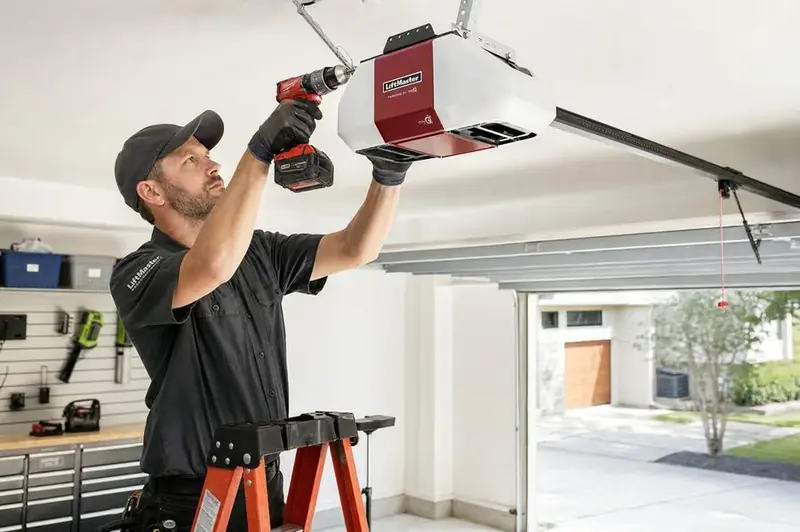
Every garage door opener falls into one of three drive types — chain, belt or jackshaft — and the difference between them affects everything from how loud your garage sounds at 6am to whether an opener will even fit your ceiling. Here's how to choose correctly the first time.
How each drive type actually works
A chain-drive opener uses a metal chain, like a bicycle chain, to pull the trolley (and the door) along an overhead rail. It's the oldest, simplest and most affordable design, and it's still the standard on many builder-grade installations.
A belt-drive opener uses the same overhead rail system but replaces the chain with a rubber-and-fibreglass reinforced belt. Mechanically it's nearly identical to a chain drive — the difference is entirely in the connector between the motor and the trolley.
A jackshaft opener is a completely different design. Instead of an overhead rail, it mounts on the wall beside the door and drives the torsion spring shaft directly. There's no rail at all, which is why jackshaft units are popular for garages with low or obstructed ceilings, or for anyone who wants to park a lift, storage rack, or finished ceiling where a rail would normally go.
Noise level compared
This is the single biggest reason homeowners switch drive types. Chain drives are the loudest — metal-on-metal contact transmits vibration through the rail and into the ceiling joists, which is especially noticeable if there's a bedroom above the garage. Belt drives are dramatically quieter because rubber absorbs vibration instead of transmitting it. Jackshaft openers are also very quiet in operation, though the motor itself sits closer to living space on an exterior wall, so placement matters.
If noise is your top priority and you have a standard ceiling, a belt-drive LiftMaster opener is usually the simplest fix.
Cost differences installed in the GTA
Chain-drive openers remain the least expensive option to buy and install. Belt-drive units typically run a modest premium over chain drive for the same horsepower and feature set — a reasonable trade for the noise reduction. Jackshaft openers cost more overall, mainly because installation is more involved: the technician needs to confirm the door's torsion spring and shaft setup is compatible, and mounting/wiring an exterior wall unit takes longer than hanging an overhead rail. See our GTA cost guide for full installed price ranges.
Ceiling clearance: why jackshaft wins for low headroom
Standard chain and belt-drive openers need roughly 12 inches of clearance above the door's highest point of travel to mount the rail and motor head. Garages with low headroom, exposed ductwork, a finished ceiling, or a storage lift often can't accommodate this. Because a jackshaft opener mounts on the wall and drives the shaft directly, it eliminates the ceiling clearance requirement entirely — this is the main reason jackshaft models exist and the main reason to choose one.
Maintenance and lifespan by drive type
Chain drives need periodic lubrication and occasional chain tension adjustment as the chain stretches with use. Belt drives need far less maintenance since belts don't stretch or require lubrication the same way. Jackshaft openers, because they connect directly to a properly balanced torsion spring system, put less repetitive stress on the opener motor itself — but they depend entirely on the door's springs being correctly balanced, since the opener has no separate lifting mechanism of its own.
Which LiftMaster models come in each drive type
LiftMaster's residential lineup covers all three drive types. Chain and belt-drive options are available across their standard and Elite Series overhead-rail openers, while the LiftMaster 8500W Elite Series is their flagship wall-mount jackshaft unit, with battery backup and MyQ smart connectivity built in.
Best pick by home type
- Standard attached garage, no bedroom above: chain drive is fine and budget-friendly
- Bedroom or living space above or beside the garage: belt drive for noise reduction
- Low ceiling, finished ceiling, or storage lift/rack overhead: jackshaft is often the only option that fits
- Detached garage converted to a gym, studio or workshop: jackshaft, for both quiet operation and full ceiling use
Horsepower and lifting capacity across all three drive types
Drive type and horsepower are separate specifications that often get conflated. A chain, belt, or jackshaft opener can all be built with comparable horsepower ratings — typically 1/2 HP for standard residential doors and 3/4 HP to 1.25 HP (or DC-motor equivalents) for heavier insulated or oversized doors. The drive type determines how that power is delivered to the door, not how much power is available. When sizing an opener for a heavier GTA-market door — full insulated steel, wood-look composite, or oversized custom doors common in newer Vaughan and Markham builds — matching horsepower to door weight matters more than the drive mechanism choice.
Installation differences that affect cost
Chain and belt openers mount overhead along a rail, following a fairly standardized installation process regardless of garage layout. Jackshaft openers mount on the wall beside the door and connect directly to the torsion shaft, which requires the shaft and bracket setup to be accessible and often benefits from professional installation to get cable tension and shaft alignment correct. This is one reason jackshaft units, while priced similarly to premium chain or belt openers, often carry a modestly higher installation labour cost.
Which drive type suits which garage layout
- Standard attached garage with ceiling clearance: chain or belt drive both work well; choose belt if noise matters, chain if budget is the priority
- Garage with limited ceiling height or storage racks near the ceiling: jackshaft is often the better fit since it frees up the overhead rail space entirely
- Bedroom or living space directly above or adjacent to the garage: belt or jackshaft drive both minimize noise transfer significantly better than chain
- Detached garage or workshop where noise is not a concern: chain drive offers the best value with no meaningful downside
Long-term maintenance differences
Chain drives need periodic lubrication and occasional chain tension adjustment as the chain stretches slightly over years of use. Belt drives require essentially no lubrication and the belt itself typically lasts the life of the opener without adjustment. Jackshaft units, because they connect directly to the torsion shaft rather than a separate rail mechanism, have fewer moving parts exposed to wear, though the shaft and cable system still needs the same spring and cable maintenance any torsion-spring door requires regardless of opener type.
Which option DPS recommends for most GTA homeowners
For a typical attached garage in Toronto, Mississauga, Vaughan or Brampton without unusual space constraints, a belt-drive opener paired with a reputable brand like LiftMaster tends to offer the best balance of quiet operation, reasonable price, and long-term reliability. Chain drive remains the right call for detached garages or budget-focused installations where noise simply isn't a factor. Jackshaft units are worth the extra installation consideration specifically when ceiling storage or an unusually low garage ceiling makes an overhead rail impractical. Our technicians assess your specific garage layout, door weight, and noise sensitivity during a free estimate visit and recommend the option that actually fits your home rather than defaulting to whichever unit has the best margin.
FAQ
Can I convert my existing overhead opener to a jackshaft without changing the door?
Usually yes, provided the door has a compatible torsion spring and shaft — this is something a technician should verify on-site before quoting.
Is a jackshaft opener overkill for a normal garage?
Not necessarily — many homeowners choose it purely for the clean ceiling and quiet operation, even without a headroom restriction.
Do belt-drive openers wear out faster than chain drives?
No — quality belt drives typically match or exceed chain-drive lifespan, since the belt doesn't stretch the way a chain does over years of use.