
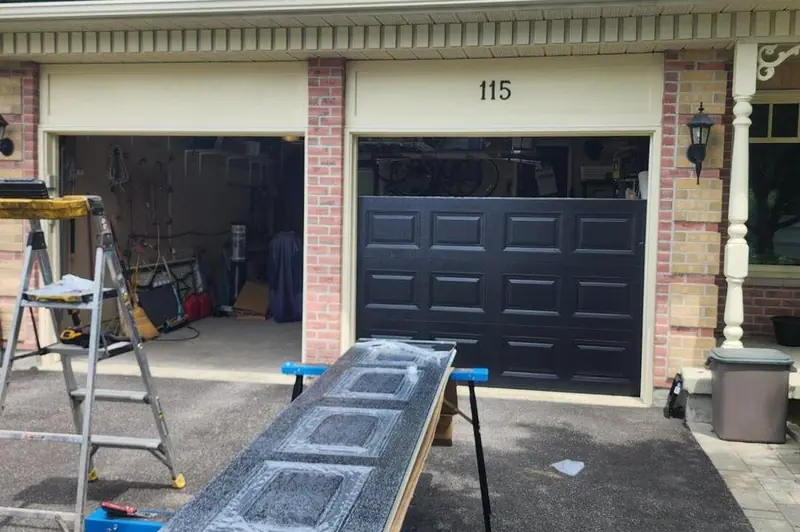
Century homes in Rosedale, Forest Hill and the Annex weren't built with garages in mind — most were added decades later, which means the garage door is often the newest, most modern-looking element on a heritage streetscape. Get the style wrong and it stands out for the wrong reasons. Get it right and it looks like it was always meant to be there.
Why century homes need a different approach
A standard flush steel door that looks fine on a 1990s subdivision home reads as jarring against Edwardian brick, limestone trim and mature tree canopies. Homeowners in these neighbourhoods are usually not just buying a garage door — they're protecting the resale value and streetscape harmony of a house that may be worth two to three times the GTA average. The door needs to visually disappear into the architecture rather than compete with it.
Rosedale and Forest Hill also tend to have narrower laneways, detached coach-house-style garages, and openings that were cut into existing structures rather than designed from scratch — all of which affect what will actually fit and function well.
Carriage-house style doors: the heritage-friendly default
Carriage-house doors — designed to mimic the swing-open wood doors of a 19th-century stable or coach house — are by far the most common choice for century homes across the GTA's older neighbourhoods. They use a standard sectional, roll-up track system (so they open and close like a normal automatic door) but the panel design, faux hinges, and handles create the visual impression of hinged wood doors.
Look for models with:
- Recessed panel designs with a raised, dimensional look rather than flat stamped steel
- Decorative (non-functional) strap hinges and handles in a matte black or oil-rubbed bronze finish
- Arched top sections if the original house has arched windows or doorways
Material choice: real wood vs. wood-composite vs. steel with wood-grain finish
There are three realistic material paths for a heritage-style door, and each has trade-offs worth understanding before you commit:
- Solid wood gives the most authentic look and is sometimes required for designated heritage properties, but it needs re-staining every few years and is the most expensive option to buy and maintain in Toronto's humidity swings.
- Composite wood-look doors use a wood-fibre composite skin over a steel or aluminum frame — very close to real wood in appearance, better dimensional stability, and far less maintenance.
- Steel doors with a wood-grain laminate or embossed finish are the most budget-friendly and lowest-maintenance option. Manufacturers like Richard Wilcox offer wood-grain steel finishes that read convincingly as wood from the street.
For most Rosedale and Forest Hill homeowners who aren't in a formally designated heritage district, a steel door with a quality wood-grain finish delivers 90% of the look at a fraction of the long-term cost. See our Richard Wilcox door styles for finish and panel options.
Matching hardware to period details
Hardware is what separates a door that "looks heritage" from one that just looks generic. Match the door's hinges, handles and window lites to details already present on the house — the same finish as the front door hardware, the same window-lite pattern as the home's original windows, and hinge placement that mimics the original coach-house swing pattern (even though the door itself rolls up).
Colour matching brick, stone and trim
Century homes in these neighbourhoods usually have deep red or buff brick, limestone or sandstone trim, and painted wood accents. Common winning combinations:
- Deep charcoal or black doors against red brick and white trim — a classic, timeless pairing
- Forest green or navy doors on buff-brick homes with cream trim
- Natural wood-tone doors on homes with stone facades and minimal painted trim
Avoid bright white or light grey doors on century homes — they tend to look institutional rather than residential against older masonry.
Insulation without ruining the look
Many century-home garages were never insulated to begin with, since garages weren't originally part of the house envelope. A double-layer or triple-layer steel door with polyurethane insulation (see our insulation guide) adds real R-value without changing the exterior appearance at all — the wood-grain finish or carriage-house panel look is applied to the outer steel skin regardless of what's insulating the inside.
Permits and heritage-district considerations
Some pockets of Rosedale and Forest Hill fall within a Heritage Conservation District or have individually listed/designated properties under Toronto's Heritage Register. If your home is designated, exterior alterations — including garage door replacement — may require Heritage Preservation Services sign-off before work begins. Check your property's status with the City of Toronto before ordering a new door, since designated properties sometimes have specific material or colour restrictions. Most GTA homes are not individually designated, but it's worth the five-minute check.
What this costs in Rosedale, Forest Hill and the Annex
Expect a premium of roughly 20–40% over a standard steel door for carriage-house styling, upgraded hardware and a wood-grain or composite finish. Installed pricing on these neighbourhoods' typical single-car openings generally lands in the same range covered in our Toronto & GTA cost guide, with the heritage-style upgrades applied on top of the base door cost.
Heritage designation considerations before replacing a door
Parts of Rosedale and Forest Hill fall under heritage conservation district guidelines or individual heritage listings through the City of Toronto, which can affect what exterior changes are permitted, including garage doors visible from the street. Before ordering a new door, check whether your specific property is listed on the City of Toronto's heritage register, since heritage properties sometimes require a heritage permit for street-facing exterior alterations, even for something as functional as a garage door.
Working with narrow or non-standard century-home openings
Many century homes in these neighbourhoods were built before standardized garage sizing existed, meaning openings are sometimes narrower, shorter, or oddly proportioned compared to modern stock door sizes. Custom-width or custom-height doors carry a cost premium over stock sizing, but attempting to force a standard-size door into a non-standard opening compromises both appearance and weatherproofing. An in-person measurement is essential here — a quote based on an estimated size rather than an actual site visit is unreliable for these older properties.
Coach house and laneway garage considerations
Forest Hill and parts of Rosedale include detached coach houses and laneway garages, some of which predate vehicle sizing standards entirely and were originally built for horse-drawn carriages or early automobiles. These structures often need door width verification more carefully than typical attached garages, and the structural opening itself sometimes needs minor reinforcement to support a modern door and opener safely.
Real cost expectations for a premium century-home upgrade
A custom-sized carriage-house style door with premium wood-look finish and appropriate insulation for these neighbourhoods' larger, often older homes typically sits at the higher end of our Toronto and GTA cost guide, reflecting both the custom sizing and the premium materials homeowners in these areas typically choose to match their home's character. Budgeting for professional installation rather than a lower-cost generic swap pays off significantly on higher-value century homes, where an ill-fitting door is much more visually noticeable than on a newer, more generic facade.
FAQ
Do I need heritage approval to replace my garage door in Rosedale?
Only if your specific property is individually designated or sits in a Heritage Conservation District. Most Rosedale properties are not designated, but always confirm with the City before ordering.
Can I get a carriage-house look with an automatic opener?
Yes — nearly all carriage-house style doors sold today use a standard roll-up track and are fully compatible with automatic openers, including LiftMaster openers.
What's the most durable material for a century home garage door in Toronto's climate?
Insulated steel with a wood-grain or composite overlay generally outperforms solid wood for long-term durability against Toronto's freeze-thaw cycles and humidity swings, while still delivering an authentic heritage look.